
Introduction:
Getting consistent leads is one of the biggest challenges for a small business. You may have a good product or service, but reaching the right customers online can be difficult without a clear strategy.
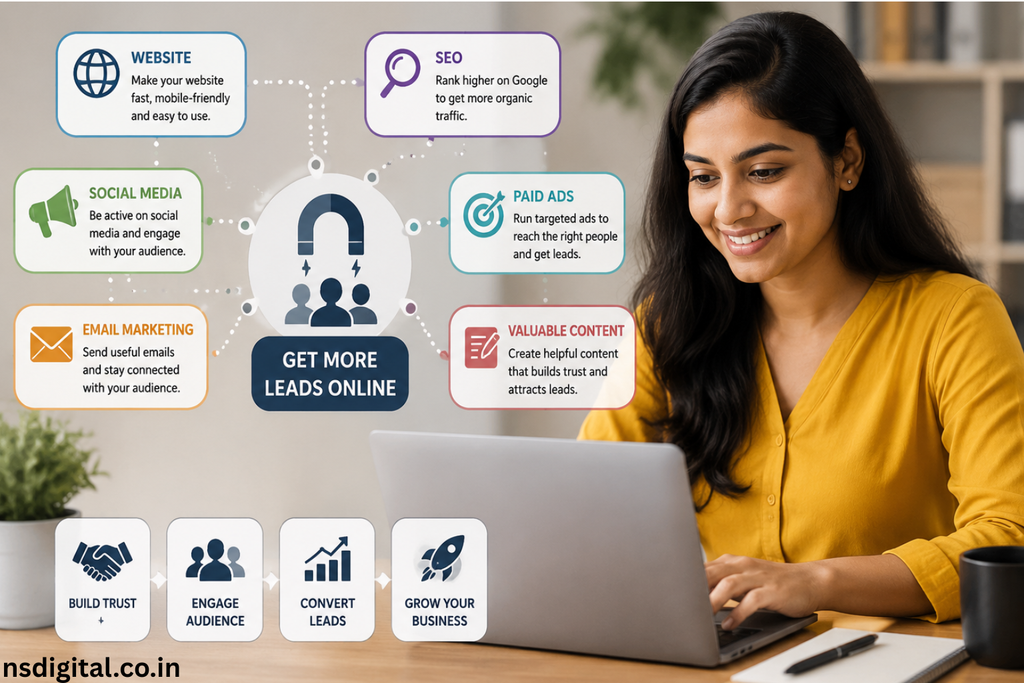
So, how can a small business get more leads online? The most effective approach is to combine SEO, a conversion-focused website, local search, social media, useful content, Google Business Profile, and other digital marketing channels. The goal is not simply to get more website visitors, but to attract the right people and turn them into potential customers.
In this guide, we will explain practical and proven ways to generate more leads online for a small business.
What Is Online Lead Generation?
The method of attracting in customers who are interested in your products or services and persuading them to do something, like completing a contact form, giving you a call, sending a WhatsApp message, asking for a price, or scheduling a consultation, is known as online lead generation.
For example, if you run a digital marketing agency, someone searching for “digital marketing agency near me” may visit your website. If they contact you for a consultation, that visitor has become a lead.
The basic process is:
Online visibility → Website or landing page → Customer interest → Contact or inquiry → Lead
A successful lead generation strategy focuses on every stage of this journey.
10 Effective Ways to Get More Leads Online:-
1. Build a Conversion-Focused Website
Your website is often the first place where potential customers learn more about your business. A professional website can build trust and make it easier for visitors to contact you.
Your website should clearly explain:
- What your business offers
- Who your services are for
- Why customers should choose you
- Your main benefits
- Contact information
- Testimonials or reviews
- Clear calls to action
Use visible CTAs such as “Get a Free Consultation,” “Request a Quote,” “Contact Us,” or “Book a Call.”
A website should not only look professional; it should make the next step obvious.
2. Use SEO to Attract People Searching for Your Services
Search engine optimization (SEO) helps your website more visible when potential customers use search engines to search for pertinent products, services, or solutions.
For small businesses, SEO can be a valuable long-term source of leads because it helps you reach people who are already looking for what you offer.
Start by targeting relevant keywords based on customer intent.
For example, instead of targeting only a broad keyword like “digital marketing,” a small agency could target phrases such as:
- Digital marketing services for small businesses
- SEO services for local businesses
- Social media marketing agency
- Digital marketing agency near me
Create useful pages and blog posts around these topics and answer the questions your potential customers are actually asking.
3. Optimize Your Google Business Profile
For businesses serving a specific location, a Google Business Profile can help potential customers discover the business through local search and Google Maps.
Keep your profile updated with:
- Correct business name and contact details
- Business category
- Website link
- Opening hours
- Services
- Photos
- Customer reviews
- Regular updates or posts
Positive reviews can also help build trust. Encourage genuine customers to share honest feedback after using your products or services.
Local SEO is especially important for businesses such as restaurants, agencies, salons, clinics, consultants, home-service providers, and retail stores.
4. Create Helpful Content
Content marketing can attract potential customers before they are ready to buy.
Instead of constantly promoting your business, create content that solves customer problems and answers common questions.
For example, a web design company could publish:
- How Much Does a Business Website Cost?
- What Should a Small Business Website Include?
- Website vs Social Media: Which Is Better for Your Business?
Useful content can attract organic traffic, demonstrate expertise, and build trust with potential customers.
It can also support SEO by giving search engines more relevant information about your business and topics.
5. Use Social Media Strategically
Social media can help small businesses reach new audiences, build relationships, and bring potential customers back to their website.
Choose platforms based on where your target audience spends time rather than trying to maintain every social network.
You can share:
- Educational tips
- Customer success stories
- Product demonstrations
- Behind-the-scenes content
- Short videos
- FAQs
- Industry insights
- Offers and promotions
Always give interested users a simple next step, such as visiting your website, sending a message, or requesting more information.
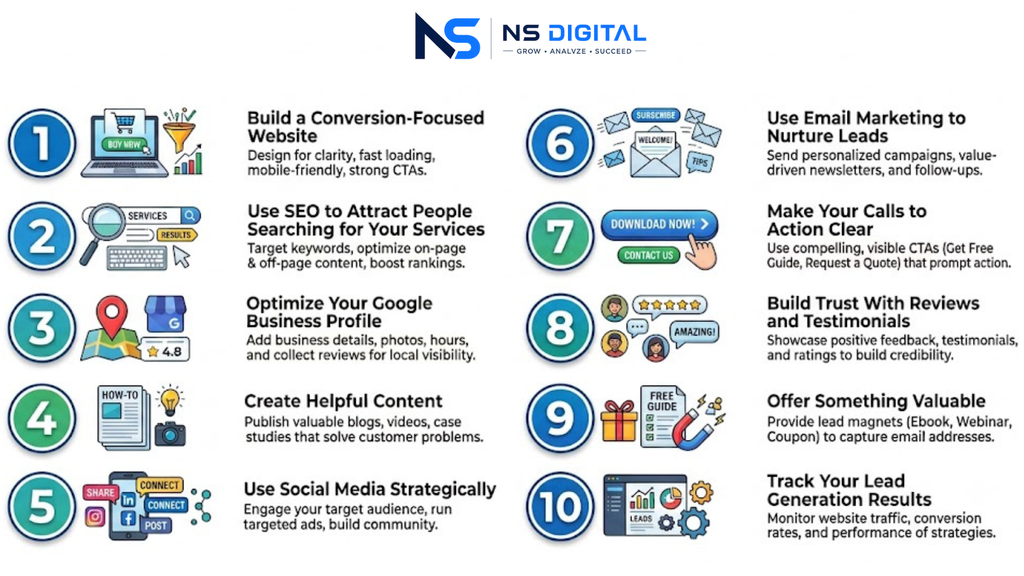
6. Use Email Marketing to Nurture Leads
Not every visitor will convert into a client right away. Before making a decision, some people require more details.
You can maintain contact with these potential customers by using email marketing.
For instance, you could provide an useful checklist, guide, or additional resource in return for an email address. You can send useful information, updates, case studies, and pertinent offers to individuals who sign up for your email list.
Instead of continuously providing advertising messages, the objective is to develop trust.
7. Make Your Calls to Action Clear
A common reason businesses lose potential leads is that visitors do not know what to do next.
A call to action tells visitors what action they should take.
Examples include:
- Get a Free Quote
- Book a Consultation
- Call Now
- Send a WhatsApp Message
- Request More Information
- Start Your Project
Place CTAs naturally throughout important pages, especially near sections where you explain your services and benefits.
A clear CTA can reduce friction and make it easier for interested visitors to become leads.
8. Build Trust With Reviews and Testimonials
People are more likely to contact a business when they trust it.
Customer reviews, testimonials, case studies, ratings, and examples of previous work can provide social proof.
For service businesses, case studies can be particularly useful because they show the problem, the solution, and the result.
For example:
Problem: A small business was receiving very little organic traffic.
Solution: An SEO and content strategy was implemented.
Result: The business improved its search visibility and received more relevant inquiries.
Always use genuine customer experiences and avoid making unsupported claims.
9. Offer Something Valuable
A useful offer can encourage visitors to take the first step.
Depending on your business, you could offer:
- Free consultation
- Free website audit
- Free initial discussion
- Product demo
- Free estimate
- Downloadable guide
- Free business checklist
The offer should be relevant to your target audience and provide genuine value.
For example, a digital marketing agency could offer a free website or SEO audit to help businesses identify opportunities for improvement.
10. Track Your Lead Generation Results
You cannot improve what you do not measure.
Track important metrics such as:
- Website visitors
- Organic traffic
- Contact form submissions
- Phone calls
- WhatsApp inquiries
- Consultation bookings
- Conversion rate
- Leads by marketing channel
This helps you understand which channels are generating useful leads.
For example, if SEO is bringing highly relevant visitors while another channel is generating traffic but very few inquiries, you can adjust your strategy based on the data.
How Can SEO Help a Small Business Get More Leads?
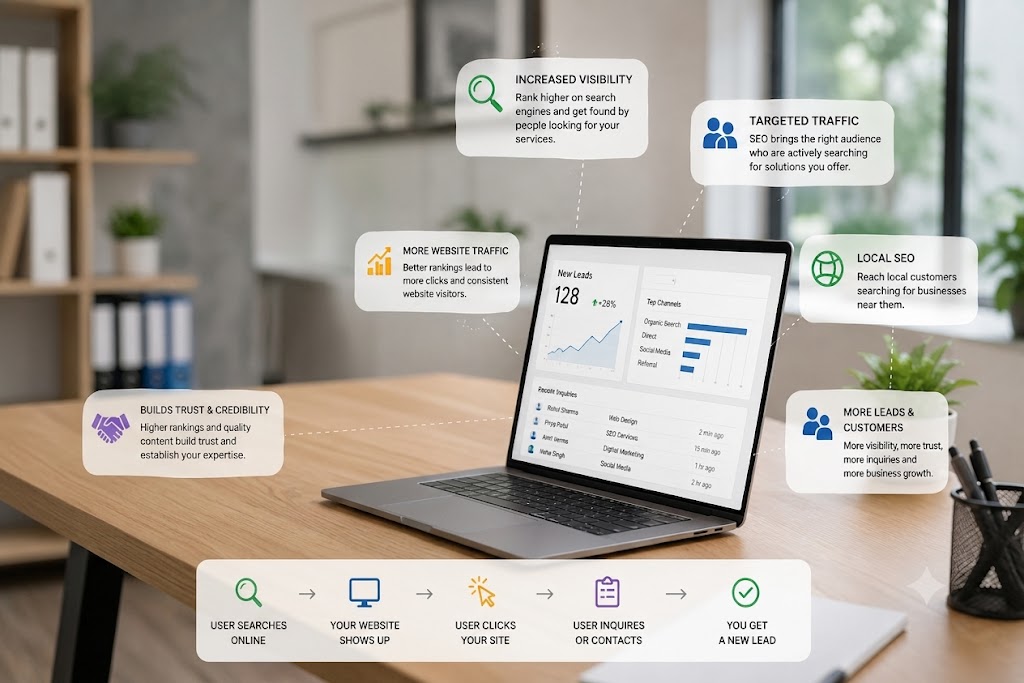
SEO can help a small business reach customers at the exact moment they are searching for a solution.
For example, someone searching for “best digital marketing agency for small business” already has a potential need. If your website provides a useful, relevant answer and a clear way to contact you, that search can become a lead.
To make SEO more effective:
- Research relevant customer keywords.
- Create useful and original content.
- Optimize important website pages.
- Improve local SEO where relevant.
- Build trustworthy backlinks and online mentions.
- Keep your website technically healthy.
- Monitor rankings, traffic, and conversions.
The key is to focus on search intent, not just keyword rankings.
How Can a Small Business Generate Leads Without Spending a Lot?
Small businesses do not always need a large marketing budget to start generating leads online.
You can begin with relatively low-cost strategies such as:
- Local SEO
- Google Business Profile optimization
- Helpful blog content
- Organic social media
- Customer reviews
- Referral marketing
- Email marketing
- Website optimization
These methods require consistency and effort, but they can create a strong foundation for long-term growth.
Paid advertising can also be useful when you want faster visibility, but it should be supported by a strong website and clear conversion process.
Why Are Online Leads Important for Small Businesses?
Online lead generation allows small businesses to reach potential customers beyond their immediate network.
A strong online presence can help you:
- Reach more potential customers
- Build brand awareness
- Generate inquiries consistently
- Establish credibility
- Reduce dependence on referrals alone
- Understand customer behavior
- Create multiple sources of leads
Instead of relying on one marketing channel, businesses can create a connected system where SEO, content, social media, local search, and the website work together.
What Is the Best Lead Generation Strategy for a Small Business?
There is no single strategy that works equally well for every business. The best approach depends on your industry, target audience, location, budget, and business goals.
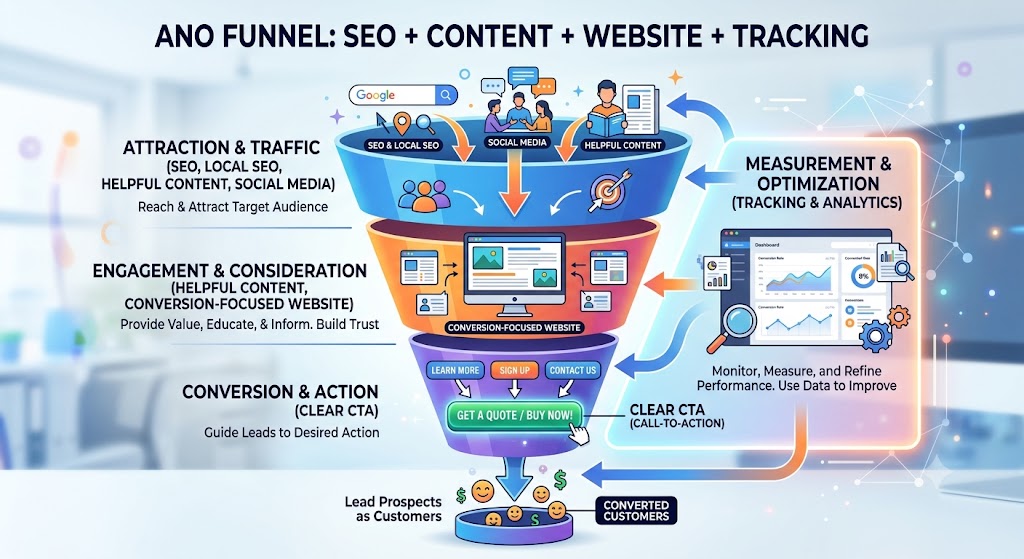
However, a strong foundation usually includes:
SEO + Local SEO + Helpful Content + Social Media + Conversion-Focused Website + Clear CTA + Tracking
For a local service business, local SEO and Google Business Profile may be especially important. For an online business, content marketing and SEO may play a larger role.
The most effective strategy is the one that consistently reaches your ideal customers and turns their interest into measurable inquiries.
Final Thoughts
Getting more leads online is not about being everywhere. Focus on SEO, a strong website, local search, useful content, social media, and clear CTAs. By consistently reaching the right audience and building trust, your small business can turn online visibility into real leads and customers.