
Introduction:
In today’s digital world, businesses need a strong online presence to reach customers, build trust, and increase sales. When starting digital marketing, many business owners ask the same question: Website vs Social Media for business — which one is better?
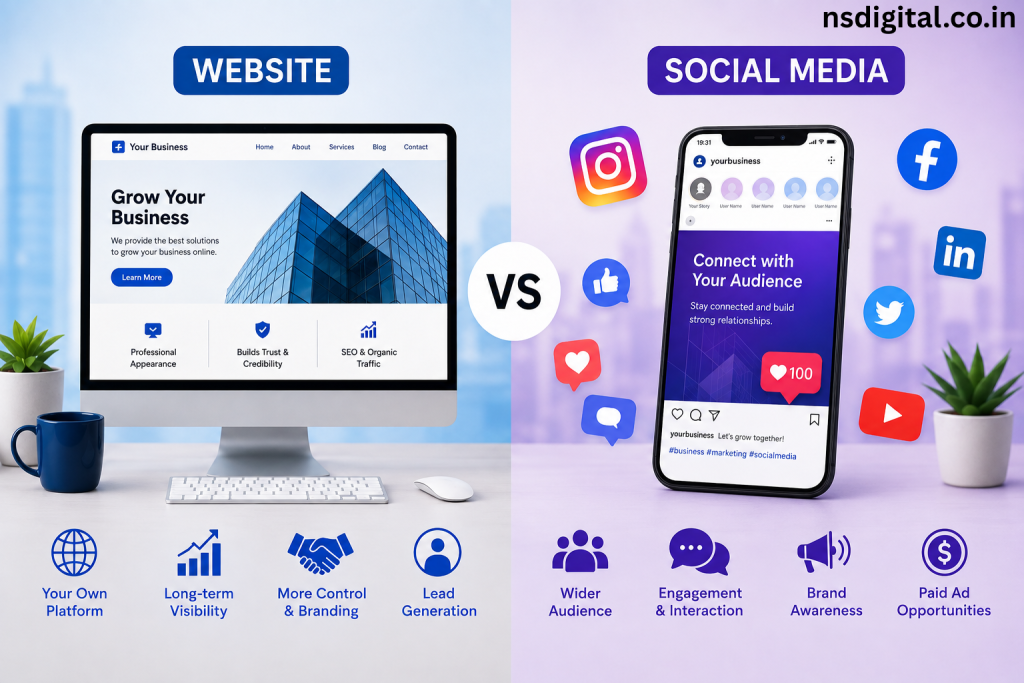
A website and social media both play an important role in digital marketing, but they serve different purposes. A website gives your business a professional online home where customers can learn about your products or services, while social media helps you connect with your audience, share content, and build relationships.
Choosing between a website and social media does not always have to be an either-or decision. In fact, businesses can get better results by using both together.
In this blog, we will compare a website vs social media for business, understand their benefits, and help you decide which option is right for your business.
What Is a Business Website?
The official internet presentation of your organization is a business website. It makes information about your business available for prospective clients at all times.
Your website can include important pages such as:
- Home
- About Us
- Services or Products
- Blog
- Contact Us
- Testimonials
- FAQs
- Landing Pages
You create greater influence over your brand, content, design, and customer experience when you have a website. Your website is not reliant on modifications to the design or algorithms of another platform, unlike social media websites.
For example, if someone searches for your service on Google, a well-optimized website can help your business appear in search results. This can bring visitors who are already interested in what you offer.
What Is Social Media Marketing?
Using social media platforms like Facebook, Instagram, LinkedIn, and other networks to promote your business and communicate with customers is also known as social media marketing.
Social media is useful for sharing:
- Images and videos
- Educational content
- Offers and promotions
- Customer reviews
- Business updates
- Reels and short videos
- Behind-the-scenes content
- Polls and questions
Social media makes communication faster and more interactive. Customers can comment on your posts, send messages, share your content, and directly interact with your business.
This makes social media an important part of a modern digital marketing strategy.
Website vs Social Media: The Main Difference.
The biggest difference between a website and social media is control and purpose.
Your website is an online property that you control. You decide how it looks, what information it contains, and how customers move through it.
Social media, on the other hand, is a platform owned and controlled by another company. You create a business profile there, but the platform controls its features, algorithms, policies, and reach.
Here is a simple comparison:
| Feature | Website | Social Media |
|---|---|---|
| Brand control | High | Limited |
| Customer interaction | Moderate | High |
| Search visibility | Strong with SEO | Platform dependent |
| Content control | High | Platform dependent |
| Trust and credibility | Very strong | Strong |
| Lead generation | Strong | Strong |
| Direct communication | Contact forms, email, chat | Comments and messages |
| Long-term value | High | Depends on platform |
| Content discovery | Google/search engines | Social feeds |
| Professional presence | High | High |
Both options are useful, but they work in different ways.
Benefits of Having a Business Website:-
1. Builds Professional Credibility
A professional website can make your business look more trustworthy. When customers search for your business and find a well-designed website, they can easily understand who you are and what you offer.
Your website can display your services, customer reviews, previous work, contact information, and other important details.
For many customers, having a website creates a stronger first impression.
2. Helps You Get Found on Google
One of the biggest benefits of a website is search engine optimization, also known as SEO.
With proper SEO, your website can rank for keywords that your potential customers search for on Google.
For example, a digital marketing company can create content around keywords related to digital marketing services, SEO, social media marketing, and online advertising.
Unlike a social media post that may receive attention for a short period, an optimized website page or blog post can continue attracting search traffic over time.
3. Gives You Full Control
Your website gives you much more control over your online presence.
You can choose:
- Your design
- Your colors
- Your content
- Your images
- Your services
- Your contact forms
- Your landing pages
- Your calls to action
You are not limited to the layout of a social media platform.
4. Supports Lead Generation
A website can be designed specifically to generate leads.
You can add contact forms, WhatsApp buttons, inquiry forms, appointment options, downloadable resources, and landing pages.
For example, a service business can create a landing page that explains one specific service and encourages visitors to submit their details.
This makes your website an important part of a digital marketing funnel.
5. Works 24/7
Your website can provide information to customers at any time.
Even when your business is closed, visitors can learn about your services, read your blogs, check your portfolio, and submit inquiries.
This gives potential customers an easy way to connect with your business whenever they are ready.
Benefits of Social Media for Business:-
1. Helps You Reach a Wider Audience
Social media can help businesses reach new people through organic content, shares, recommendations, hashtags, and paid advertising.
A single engaging post or video can reach many users and introduce your brand to potential customers.
This makes social media especially useful for increasing brand awareness.
2. Creates Direct Customer Interaction
Social media allows businesses to communicate directly with their audience.
Customers can comment on posts, ask questions, send direct messages, and share feedback.
This two-way communication helps businesses understand their customers better and build stronger relationships.
3. Great for Visual Content
If your business depends on visuals, social media can be extremely useful.
Businesses such as restaurants, fashion brands, beauty businesses, interior designers, photographers, and creative agencies can use images and videos to showcase their work.
Short-form videos and reels can also help businesses attract attention quickly.
4. Supports Brand Awareness
Social media allows you to show your brand personality regularly.
By consistently sharing useful and engaging content, you can stay in front of your audience.
For example, a business can post educational tips on Monday, a customer review on Wednesday, and a service-related video on Friday.
Over time, this consistent presence can help people remember your brand.
5. Useful for Paid Advertising
Social media platforms also provide advertising opportunities.
Businesses can run campaigns based on different goals, such as:
- Brand awareness
- Website traffic
- Lead generation
- Engagement
- Sales
- App promotion
This allows businesses to target specific audiences and promote their products or services more strategically.
Website vs Social Media: Which One Should You Choose?
The answer depends on your business goals.
If you want to build long-term online credibility, attract search traffic, generate leads, and create a professional online presence, a website should be a priority.
If your main goal is to increase awareness, engage with customers, share visual content, and build an online community, social media should be a major part of your strategy.
However, the best approach for most businesses is not choosing only one.
Use a Website When You Need:
- Long-term online visibility
- Google search traffic
- A professional business presence
- Detailed service information
- Lead generation
- Landing pages
- SEO
- A central place for your online marketing
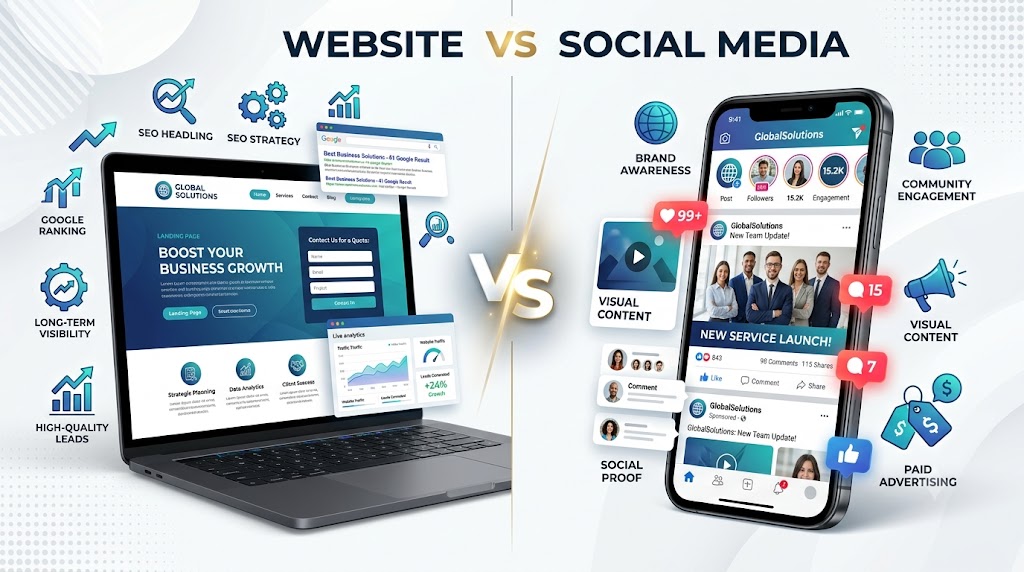
Use Social Media When You Need:
- Brand awareness
- Audience engagement
- Fast communication
- Visual content promotion
- Community building
- Social proof
- Paid social advertising
Why Your Business Should Use Both?
Instead of thinking about website vs social media as a competition, think of them as two parts of the same digital marketing strategy.
Your website can act as the central hub of your online presence, while social media can help bring people to that hub.
For example, you can create a helpful blog post on your website and then share it on Facebook, Instagram, LinkedIn, or other social platforms.
Similarly, you can create a social media post about one of your services and direct interested users to a relevant website page.
This creates a simple marketing journey:
Social Media → Website → Information → Trust → Lead → Customer
This combination can be more effective than depending on only one platform.
Website or Social Media: What Should a Small Business Start With?
If your business is new and has a limited budget, you may wonder where to start.
A simple approach is to first create a professional website with the most important information about your business. You do not necessarily need dozens of pages.
Start with the basics:
- Home page
- About page
- Services page
- Contact page
- One or more useful landing pages
Then create social media profiles that match your business goals.
Once your foundation is ready, focus on creating useful content and promoting your website through social media.
The important thing is to remain consistent rather than trying to do everything at once.
Common Mistake: Depending Only on Social Media.
Relying only on social media can limit your business growth. Algorithms and reach can change anytime, and you have limited control over the platform. A professional website gives your business a stable online presence, better credibility, and more opportunities to generate leads.
Final Thoughts
A website and social media both play an important role in business growth. A website builds trust and brings long-term value, while social media helps you reach and engage with your audience. Using both together can create a stronger online presence and help your business grow.