
Introduction
Content marketing Strategy is a strategic marketing approach focused on developing and distributing useful, relevant, and consistent content that attracts the right audience and encourages meaningful engagement. Rather than relying on direct sales messages, content marketing helps businesses educate potential customers, solve their problems, and build lasting trust. The primary objective is to create value first, allowing businesses to naturally guide users toward actions such as making a purchase, subscribing to updates, or contacting the company .In today’s digital world, consumers expect brands to provide information before asking for a sale. By consistently publishing valuable content, businesses can strengthen their online presence, establish credibility, and create long-term customer relationships.
What Is Content Marketing?
Content marketing is a long-term strategy that involves creating and sharing informative, engaging, and relevant content designed to attract a clearly defined audience and inspire profitable customer actions.Instead of focusing only on promoting products or services, this approach centers on helping people make informed decisions. Businesses use blogs, videos, guides, social media posts, and other forms of content to answer questions, educate audiences, and solve real-world problems.
Why Is Content Marketing More Important Than Ever in 2026?
As digital competition continues to grow, businesses need more than traditional advertising to stand out. Customers are surrounded by promotional messages every day, making valuable content one of the most effective ways to capture attention and build trust. Content marketing has become an essential part of every successful digital marketing strategy because it helps businesses create meaningful connections with their audience while supporting long-term growth.
–Key benefits include-
1. Establishing strong brand credibility
2. Improving search engine visibility
3. Attracting qualified leads
4. Building customer confidence
5. Supporting every stage of the buying process
6. Reducing reliance on paid advertising
7. Strengthening customer loyalty
8. Creating valuable long-term marketing assets
9. Enhancing email marketing performance
10.Driving consistent organic website traffic
How Does Content Marketing Strategy Actually Work?
Step 1: Understand Your Audience
Successful content begins with understanding the people you want to reach.
Research your audience by identifying:
-Their biggest challenges.
-Personal and professional goals.
-Interests and preferences.
-Online search habits.
-Frequently asked questions.
The more you understand your audience, the easier it becomes to create content that genuinely meets their needs.
Step 2: Create Valuable Content
Once you understand your audience, develop content that educates, informs, and helps solve their problems.
Popular content formats include:
-Blog posts
-Educational videos
-Customer case studies
-Infographics
-Comprehensive guides
-Podcasts
-Checklists
Every piece of content should deliver practical value while building trust with your audience.
Step 3: Optimize for Search Engines
Creating excellent content is only part of the process. It also needs to be easy for people to discover through search engines.
Focus on SEO best practices such as:
-Using relevant keywords naturally
-Building internal links
-Writing compelling meta descriptions
-Organizing content with clear headings
-Optimizing images
-Ensuring mobile-friendly formatting
Well-optimized content has a greater chance of reaching users who are actively searching for related information.
Step 4: Promote Across Multiple Channels
Publishing content on your website alone is not enough. To maximize visibility, share your content across different digital platforms where your audience spends time.
Effective promotion channels include:
-Linkdin
-Instagram
-Facebook
-Email newsletters
-Online communities
-Industry forums
Content promotion helps increase reach, engagement, and overall marketing effectiveness.
Step 5: Convert Visitors into Customers
The final goal of content marketing is to encourage visitors to take meaningful action.
Guide readers toward actions such as:
-Downloading valuable resources
-Booking consultations
-Subscribing to newsletters
-Purchasing products or services
-Requesting product demonstrations
A clear and relevant call-to-action helps transform engaged readers into qualified leads and loyal customers.
What Types of Content Should Every Business Create?
An effective content marketing strategy includes a variety of content formats because every audience prefers to consume information differently. Using multiple formats helps businesses expand their reach, improve engagement, and connect with customers at different stages of their buying journey.
Blog Articles
Blog posts remain one of the most valuable content types for long-term digital growth.
They are highly effective for:
- Improving SEO performance
- Driving consistent organic traffic
- Educating potential customers
- Building industry expertise
- Answering common customer questions
Publishing informative and well-researched blogs regularly helps establish your website as a trusted source of information.
Videos
Video content continues to dominate digital marketing because it is engaging, easy to consume, and highly shareable.
Businesses use videos for:
- Step-by-step tutorials
- Product demonstrations
- Customer success stories
- Brand introductions
- Educational content
Videos help simplify complex topics while creating stronger emotional connections with viewers.
Infographics
Infographics present information in a visual format that is easy to understand.
They are ideal for:
- Explaining complicated concepts
- Presenting statistics
- Showing processes
- Comparing products or services
- Increasing social media shares
Visual content often captures attention faster than large blocks of text.
Case Studies
Case studies highlight real customer experiences and demonstrate measurable business results.
Instead of making promotional claims, they provide practical evidence of how your products or services solve problems.
A strong case study typically includes:
- The customer’s challenge
- The implemented solution
- Measurable outcomes
- Customer feedback
This type of content significantly improves credibility and trust.
Social Media Content
Short-form social media content allows businesses to stay connected with their audience on a daily basis.
Its primary goals include:
- Increasing audience engagement
- Reaching new potential customers
- Driving traffic to the website
- Building an active online community
- Promoting new content
Consistent posting helps maintain brand visibility across multiple platforms.
Email Newsletters
Email newsletters help businesses maintain long-term relationships with subscribers.
They can be used to share:
- Industry updates
- Educational articles
- Company news
- Product launches
- Exclusive offers
- Helpful resources
Regular newsletters keep your audience engaged without relying solely on social media algorithms.
E-books & Guide
Long-form downloadable resources provide in-depth knowledge on specific topics.
Businesses often use them to:
- Generate qualified leads
- Demonstrate expertise
- Educate potential customers
- Collect email subscribers
Comprehensive guides offer greater value than short-form content and often become excellent lead-generation assets.
Podcasts
Podcasts have become an increasingly popular way for professionals to consume content while commuting, exercising, or working.
Businesses use podcasts to:
- Share expert insights
- Interview industry leaders
- Discuss current trends
- Build stronger brand authority
Audio content allows audiences to learn conveniently without needing to read or watch a screen.
What Makes Great Content Stand Out?
= Original
Create content that reflects your own expertise and perspective.
Rather than copying competitors, focus on sharing fresh ideas, practical experiences, and unique insights that add genuine value.
__________________________________________
= Helpful
The best content answers real questions and solves actual problems.
Always prioritize your audience’s needs instead of writing solely to target search engine keywords.
_________________________________________
= Easy to Read
Well-structured content improves the reading experience.
Use:
+Short paragraphs
+Clear headings
+Bullet points
+Simple language
+Logical formatting
+Most readers scan a page before reading it carefully, so clarity is essential.
__________________________________________
= Accurate
+Reliable information builds trust.
+Ensure your content includes:
+Updated facts
+Current industry information
+Accurate examples
+Verified statistics whenever possible
Avoid outdated or misleading information that could reduce credibility.
____________________________________________
= Engaging
Interesting content keeps visitors reading longer.
Increase engagement by including:
+Real-world examples
+Storytelling
+Practical tips
+Relatable situations
+Easy-to-understand explanations
An engaging writing style improves user experience and encourages content sharing.
How Does Content Marketing Strategy Support SEO?
Enhancing the Content Marketing and Search Engine Optimization (SEO) work together to improve online visibility and attract qualified visitors.
Search engines prioritize websites that consistently publish valuable, relevant, and user-focused content.
Some of the biggest SEO advantages include:
~Increasing the number of indexed pages
~Improving keyword rankings
~Building stronger domain authority
~Earning high-quality backlinks
~Increasing user engagement
~Reducing bounce rates
~Overall website experience
Instead of creating content only to satisfy search engine algorithms, businesses should focus on producing content that genuinely answers users’ questions and fulfills their search intent.
When readers find value in your content, search engines are more likely to reward your website with better rankings over time.
What Is the Content Marketing Funnel?
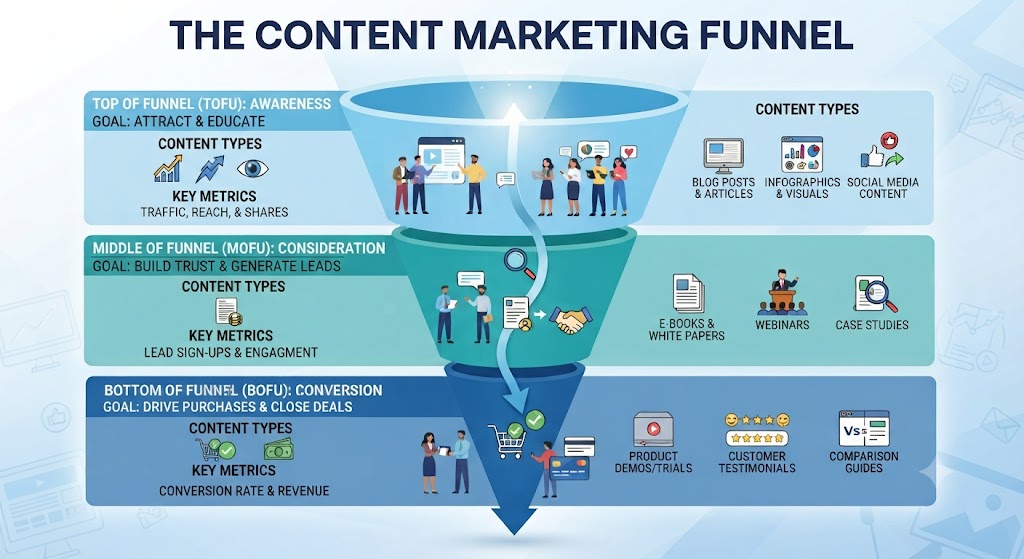
Every customer moves through different stages before making a purchasing decision. Content marketing helps guide them throughout this journey by delivering the right information at the right time
Awareness Stage:–
The primary goal at this stage is to introduce your brand and educate potential customers.
Effective content includes:
->Educational blog posts
->Social media content
->Informative videos
->Infographics
The objective is to attract attention and build initial trust.
Consideration Stage:
At this stage, potential customers are comparing different solutions and evaluating available options.
Helpful content includes:
->Buying guides
->Product comparison articles
->Webinars
->Email nurture campaigns
This content helps prospects make informed decisions while positioning your business as a trusted choice.
Decision Stage:
The final stage focuses on encouraging prospects to become customers. Content designed for conversion includes:
->Customer case studies
->Testimonials
->Product demonstrations
->Free consultations
->Limited-time offers
Each stage of the funnel serves a different purpose, and creating content for every phase helps businesses generate stronger results throughout the customer journey.
What Common Content Marketing Mistakes Should You Avoid?
Many businesses invest time in creating content but fail to achieve meaningful results because they overlook the fundamentals of an effective content strategy. Avoiding common mistakes can significantly improve your content’s performance and long-term impact.
Some of the most frequent content marketing mistakes include:
- Publishing content without a clear strategy
- Failing to understand the target audience
- Creating overly promotional content instead of providing value
- Ignoring SEO best practices
- Posting content inconsistently
- Writing weak or uninteresting headlines
- Forgetting to include a strong call-to-action (CTA)
- Copying competitors instead of offering original insights
- Neglecting performance analytics
- Allowing existing content to become outdated
Successful content marketing always prioritizes helping the audience first
How Can AI Improve Content Marketing Without Replacing Creativity?
Artificial Intelligence has become an essential tool for modern marketers, helping streamline content creation and improve efficiency. However, AI works best as an assistant rather than a replacement for human creativity.
AI can support content marketing by helping with:
- Discovering new content ideas
- Keyword research
- Creating structured content outlines
- Improving grammar and readability
- Optimizing content for SEO
- Analyzing content performance
- Repurposing existing content into different formats. Despite these advantages, human creativity remains irreplaceable.
______________________________________________________________________________
Readers connect more deeply with content that includes:
- Personal experiences
- Original viewpoints
- Authentic storytelling
- Industry knowledge
- Real-life examples
How Can You Measure Content Marketing Success?
Publishing content without monitoring its performance makes it difficult to understand what is working and where improvements are needed. Tracking the right metrics helps businesses refine their strategy and maximize future results.
Organic Traffic : Organic traffic measures the number of visitors arriving from search engines. A steady increase usually indicates that your SEO and content strategy are performing well.
______________________________________
Time on Page: This metric shows how long visitors spend reading you content.
Longer reading times generally suggest that users find the information valuable and engaging.
________________________________________
Bounce Rate : Bounce rate measures the percentage of visitors who leave your website without interacting further. A lower bounce rate often indicates that your content encourages users to continue exploring your site.
______________________________________
Conversion Rate : Conversion rate tracks how many visitors complete valuable actions, such as:
- Filling out a contact form
- Downloading a resource
- Subscribing to a newsletter
- Making a purchase
- This is one of the most important indicators of content marketing success.
________________________________________
Keyword Rankings : Monitoring keyword positions helps measure improvements in search engine visibility over time. Higher rankings typically lead to increased organic traffic and better online exposure.
______________________________________________
Social Media Engagement : Evaluate how audiences interact with your content by tracking:
- Likes
- Comments
- Shares
- Saves
- Strong engagement often reflects content that resonates with your target audience.
___________________________________________
Email Marketing Performance : Measure the effectiveness of your email campaigns through:
- Open rates
- Click-through rates
- Subscriber growth
- Reader engagement
- These metrics reveal how well your content keeps subscribers interested.
_________________________________________________
Lead Generation : Measure how many business opportunities your content creates through:
- Resource downloads
- Contact form submissions
- Consultation requests
- Product inquiries
- Consistently analyzing these metrics helps businesses make informed decisions and continuously improve their content marketing strategy.
What Is the Future of Content Marketing Strategy?
The future of content marketing will be shaped by personalization, quality, and meaningful customer experiences. As artificial intelligence continues to evolve, businesses will gain better tools for research, automation, and content optimization. However, technology alone cannot replace genuine human creativity. Long-term success will belong to brands that consistently create valuable content while adapting to changing audience expectations and digital trends.
–Final Thoughts–
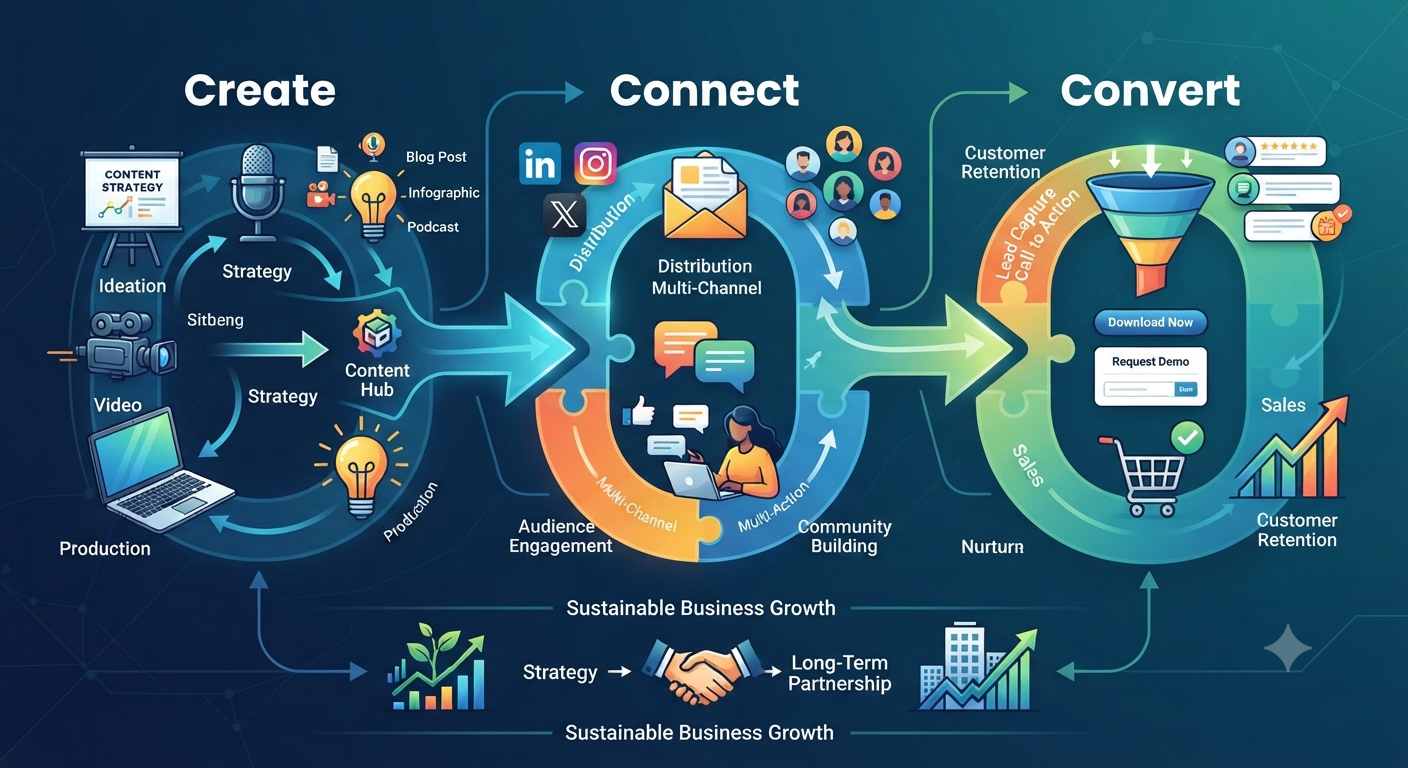
Content marketing is more than just publishing blog posts. It is about creating valuable content, building meaningful relationships with your audience, and converting visitors into loyal customers. By following the Create, Connect, Convert strategy, businesses can improve brand awareness, increase website traffic, generate quality leads, and achieve sustainable business growth.
Ready to grow your business with expert content marketing? Contact NS Digital today and let’s create a strategy that delivers real results.